Wednesday, 13 November 2013
Michael Porter Five Generic Competitive Strategies
Assalamualaikum w.b.t.
The five generic competitive
strategies include:
1)
Low-Cost
Provider
2)
Broad
Differentiation
3)
Focused
Low-Cost
4)
Focused
Differentiation
5)
Best-Cost
Provider
According Michael Porter,
strategies allow organization to gain competitive advantage from three different
bases which are:
1)
Cost leadership
2)
Differentiation
3)
Focus
Porter calls
these bases as “generic strategies”. Firstly, cost leadership refers to
producing standardized products at a very low per-unit cost for consumers who
are price-sensitive. There are two alternative types of cost leadership which
are low-cost strategy and best-value strategy. Low-cost strategy offers
products or services to a wide range of customers at a lowest price available
on the market. Meanwhile, best-value strategy offers products or services to a
wide range of customers at the best price-value available on the market. Both two
types of strategies target a large market.
Secondly, Porter’s
generic strategy is differentiation. It is a strategy aimed at producing
products and services considered unique industry wide and directed at consumers
who are relatively price-insensitive. A successful differentiation strategy
allows a firm to charge a higher price for its product and to gain customer
loyalty because consumers may become strongly attached to the differentiation features.
Special features that differentiate one’s product can include superior service,
spare parts availability, product performance, useful life, ease of use and
etc. the most effective differentiation bases are those that are hard or expensive
for rivals to duplicate.
Lastly,
Porter’s generic strategy is focus. Focus means producing products and services
that fulfill the needs of small group consumers. Two alternative types of focus
strategies are focused low-cost and focus differentiation. Low-cost focus
strategy offers products or services to a small range of customers at the
lowest price available on the market. Meanwhile, focused differentiation offers
products or services to a small range of customers at the best price-value
available on the market. It is sometimes called “best-value focus”. The aim is
to offer a niche group of customers’ products or services that meet their taste
and requirements better than rivals’ product do. Both two types focus
strategies target a small market.
Tuesday, 12 November 2013
Ashura Day @ 10 Muharram
In the name of Allah, we praise Him, seek His help and ask for His
forgiveness. Whoever Allah guides none can misguide, and whoever He allows to
falling astray, none can guide them aright. We bear witness that there is no
one worthy of worship but Allah alone, and e bear witness that Muhammad is His
messengers.
Assalamualaikum
w.b.t to all Muslims ^^
How
are you today? I hope all of us in the protection of Allah. Insha Allah. Today,
I would like to share about “Ashura Day”. As a Muslim, we already know what is “Ashura
Day” right? Ashura day is the 10th day or Muharram (the first month
of the Islamic calendar). Since the beginning of this world, Ashura day has
been a very important day. On this day, Prophets, Saints and Sincere servants
of Allah were blessed with miracles and spiritual powers. Therefore, what I can
say here is 10 Muharram is a great day! ^^
The stories behind the day of Ashura
are:
1 1)
Repentance of
Prophet Adam A.S was accepted by Allah.
2 2)
The ship of
Prophet Nuh A.S came to rest on a mountain called Al-Judi.
3 3)
Prophet Ibrahim
A.S was born on this day and he got the title Khalilullah (friend of Allah) on
this day.
4 4)
The fire in
which Prophet Ibrahim A.S was thrown by the king Namrud become cool and means
of safety for Prophet Ibrahim, by the order of Allah.
5 5)
Allah
delivered Prophet Ayub A.S from distress and he was restored to prosperity.
6 6)
By the grace
of Allah, Prophet Yunus A.S was casted out on the shore after being swallowed
by a huge fish (whale) for forty days.
Actually,
there are many stories but, I just listed some examples of the story behind the
Ashura day. Sorry. Now, I would like to talk about fasting on 10 Muharram.
Fasting
on Ashura day carries a great reward. It is better to fast both 9th and
10th of Muharram or 10th and 11th Muharram to distinguish
Muslims and Jewish because they also practice the same thing.
“Berpuasalah kamu di Hari
Ashura dan kamu bezakanlah dengan (amalan) orang-orang Yahudi. Oleh itu,
berpuasalah sehari sebelumnya dan sehari selepasnya. “
-Hadith Ahmad-
In
short, it would be “afdhal” to fasting all three days which are 9th,
10th and 11th Muharram. If not able, fast on 9th
and 10th. If not able too, it is sufficient to fasting on 10th
Muharram. It is due the fact that, our beloved Prophet Muhammad S.A.W has said
that this is the most rewarding fast next to Ramadhan. Our beloved Prophet has
also said that fasting on Ashura day will compensate for one year’s sin.
So,
I think that’s all about from me. I hope with a little sharing can be
beneficial to us in this world and the hereafter. I’m sorry if I’m wrong in
transmitting knowledge. If I’m wrong, please let me know. Thank you very much.
“Whatever written of truth and
benefit is only due to Allah’s assistance and guidance, and whatever of error
is of me. Allah alone knows best, and he is the only source of strength. May Allah
guide us to the straight path of Islam. May Allah guide us to the Siraat
al-Mustaqeem.”
Wednesday, 23 October 2013
WEEK 4 - Evaluating a company's resources, capabilities, and competitiveness.
Hi
everybody! ^^ How are you today? Today, I would like share about what I’ve
learned in chapter 4. Ok! Now, I want to ask you. What resources and
capabilities are? Take 5-10 minutes to thinks and answer my question. So now,
let’s compare your answer and my explanation about the two key words that I’ve
mentioned earlier.
Alright, now you know what
my answer is. Then, compare with your answer. Is it same with me? Or your
answer is more clearly and more suitable than me? Or your answers are differing
from me? If I make a mistake, please let me know ok! Thank you. (^_^) Therefore,
a firm’s resources and capabilities
represent its competitive assets and are big determinants of its
competitiveness and ability
to succeed in the marketplace. Resource and capability analysis is a powerful tool for sizing up a company’s competitive assets and determining if they can support a sustainable competitive advantage over market rivals.
Next, we move on VRIN test. What
is VRIN? VRIN test is for sustainable competitive advantage which means sustain
for a long-term. VRIN test ask if resources:
To identifying the firm’s
resources and capabilities by VRIN testing, the firm should ask:
●
Is the resource (or
capability) competitively Valuable?
●
Is the resource Rare—is it
something rivals lack?
●
Is the resource hard to
copy (Inimitable)?
●
Is the resource
invulnerable to the threat of substitution from different types of resources
and capabilities (Non-substitutable)?
Then, we move on SWOT
analysis. Do you know what SWOT analysis is? I believe that many of us know
what SWOT analysis is. While many can quickly understand what SWOT stands for? Basically,
S represent as strength, W as weaknesses, O
as opportunities, and T as threats. SWOT analysis is a
powerful tool for sizing up a firm. Many too forget the need for matching external
with internal factors to generate appropriate strategies.
Opportunities +
Threats = External
Strengths +
Weaknesses = Internal
I
think I should not explain more about SWOT analysis because many of us can
easily and quickly understand what SWOT analysis is. Hence, in business,
internal and external should match together. By matching these two sets of
factors, a rational strategic decision can be derived.
Lastly,
I want to explain a little bit about the concept of a company value chain. A
company’s value chain identifies the primary activities and related support
activities that create customer value. The simple example of value chain process as following:
In short, value chain analysis
facilitates a comparison, activity-by-activity; of how effectively and
efficiently a firm delivers value to its customers, and relative to its
competitors. Moreover, segregate the firm’s operations into different types of
primary and secondary activities to identify the major components of its
internal cost structure. So, I think that’s all for today. I’ve no idea to
explain more because I’m not totally 100% understand about this concept. Sorry.
(~_~) Please forgive me for the mistake that I’ve done and for the wrong
information that I’ve shared with you. Thank you. See you later! ^^
Sunday, 6 October 2013
( Evaluating a Company's External Environment )
Assalamualaikum..
Hi everyone! Today, I want
to share about what I’ve learned in my class last two weeks. Hehe. Sorry because
I’m late update my blog. (^_*) Actually, I’ve no idea to update my blog before
this. Now, I think I can share a little bit about chapter 3 (Evaluating a
Company’s External Environment). Sorry if I make a mistake especially
grammatical error. J Alright! Let’s start! Ok, first
question is what is macro-environment? Generally, macro-environment also known
as general environment includes all the environmental factors that have an
impact on all organizations and firms within the economy. It is represents factors
that will influence directly or indirectly. A simple acronym to remember the
factors is PESTEL.
The examples of each factor
as below:
The macro-environment or
PESTEL analysis, however, is not to enough to identify meaningful opportunities
and threats to a firm. A group of firms that produce similar products or sell
the same product to the same markets is defined as an industry. The industry
environment includes the key forces shaping and influencing competition in that
industry. These forces are known as Michael Porter’s Five Forces Model (1980)
and described as below:
Now, I will explain one buy
one for the five competitive forces. Firstly, threats of new entrants. A new
entrant to an industry can raise the level of competition. An industry’s
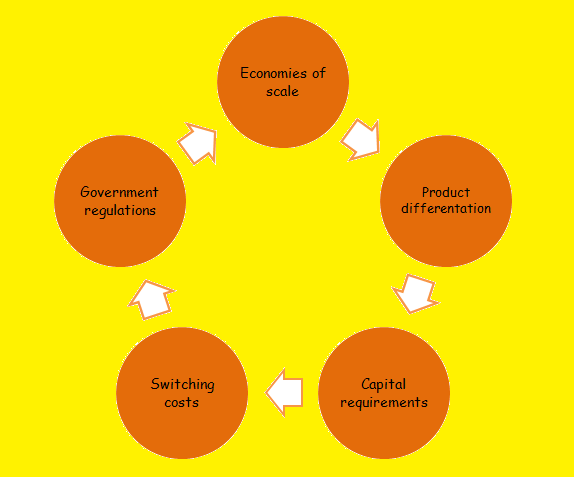
barrier-to-entry can limit the number of new entrants into the industry. Barrier-to-entry
refers to factors that can obstruct or limit the threat of new entrants. The following
have identified as barrier-to-entry for new firms into an industry:
Secondly, the bargaining power of suppliers. Suppliers are the source
for an organization to obtain the inputs such as labors, parts and raw
materials needed to produce its goods and services. For instance, a supplier
group is powerful when the suppliers’ goods are critical to the buyers’
marketplace success. Next is bargaining power of buyers. Customers are the
potential buyers of the products that are supplied by the firm in the industry.
Customers also have the most power when they are large and purchase most of the
industry’s input. Fourthly, substitute products. Generally, product substitute
present a strong threat to affirm when the customers can obtain a product which
is almost of the same quality or the same functions as a product the industry
produces and at a lower price. The substitute products can be a treat when the
product is undifferentiated. Last but not list, rivalry among competitors. Rivalry
among competitors can be most intense when there are numerous competitors in
the industry. Other than that, the rivalry among competitors can be strong and
powerful when there are high fixed costs of production.
Ok! I think I should stop here. It is because I have no idea anymore to
share more about this topic. I’m really sorry for the weaknesses. I hope what I
have explained before can help you a little bit. Alright! I stop here. Arigato!
Haik! Hehe (^_*) See you soon! ^^
Saturday, 5 October 2013
# The Business Vision and Mission #
Hi everyone! Today I would like give a short brief about the
business vision and mission. Do you know what vision is? Mission? Ok! Let’s me
tell you. Generally, vision refers to the basic question which is “What do we
want to become?” Meanwhile, mission refers to how we want to achieve the
vision. For example, if your vision is wants to be an entrepreneur, your
mission should be to get more knowledge and experience as much as possible. Other
than that, your mission may be to further your study on a higher level in field
of business. But, the vision statement should be short and preferably one
sentence. In business, a mission is a declaration of an organization’s “reason
for being.” Its reveals what an organization wants to be and whom it want to
serve.
Now! We move on the importance of vision and mission statement in an
organization.
And for the last, what components should be included in mission
statement? Ok! Let’s me tell you. There are nine components in mission
statement which are:
Alright! I think that's all for today. I have no idea to talk more. Sorry for the mistake that I'd done. Thank you for took the time to read my blog. (^_^)
* Week 1 *
ASSALAMUALAIKUM..
Hi! See you again! How are
you today? Hope all of us are fine. Ok! Without wasting time, today I would
like to share about what I’ve learned in week one. Our first topic for this
subject is The Nature of Strategic Management. First of all, I want to know
what you understand about strategic management. Ok! Think first! (???????????????)
Right now, tell yourself
what strategic management is. Done! Ok, good job! (^_^) Now, let’s me tell you
about the nature of strategic management. Strategic management refers to
determine mission, vision, values, goals, objectives, roles and
responsibilities, timeliness, and etc. Meanwhile, strategic plan is a company’s
game plan. It is used to help an organization to do better job and to ensure member
of the organization are working toward same goals.
I've already explained
about the stages of strategic management just now. Now, I’ll explain you about
the key terms in strategic management. The key terms as follows:
1)
Competitive
advantages: You have a factor that others can’t imitate.
2)
Strategists: Person
who are responsible to the success and failure of an organization.
3)
Vision & mission statement:
What do we want to become? What is our business? How?
1
4) External
opportunities and external threats: Refers to demographic, culture, social,
technological, and etc.
6) Objectives: Specific results that an organization seeks to achieve basic
mission.
7) Strategies: May include geographic expansion, diversification, product
development, and etc.
Alright,
I think that’s all for today. I will share something new that I’ve learned
after this. See you in next entry! Thank you.
Subscribe to:
Posts (Atom)


.jpg)


.jpg)
.jpg)
.jpg)
.jpg)
.jpg)

.jpg)
.jpg)